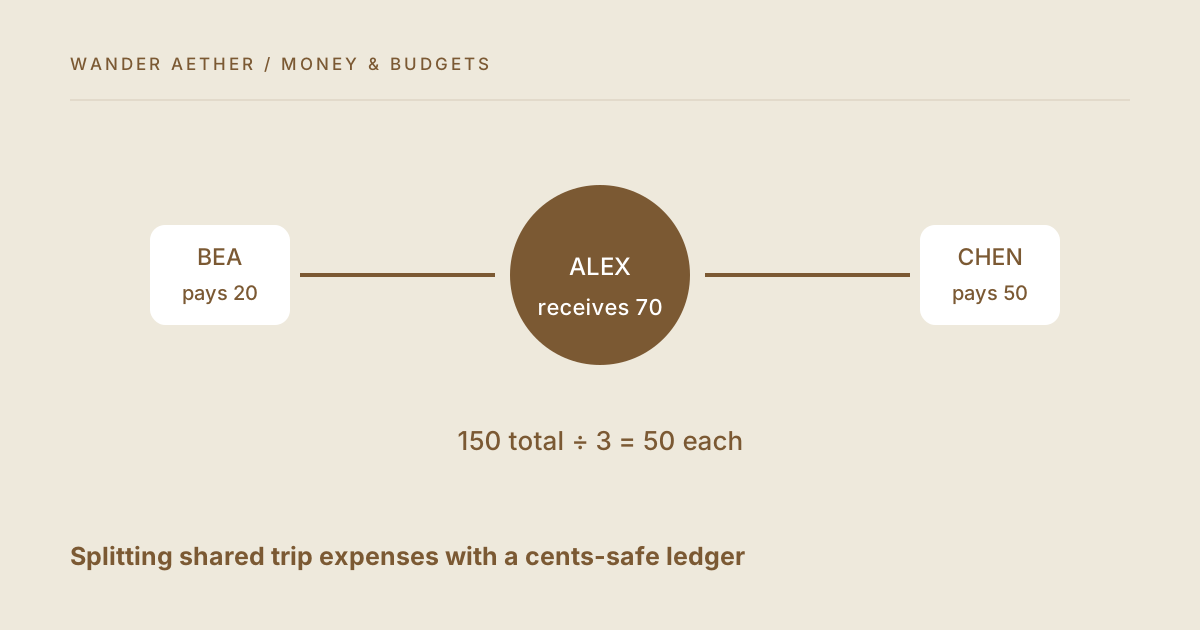
When everyone benefits equally from a set of expenses, the important settlement number is each person's total paid, not the number of receipts they hold. The expense splitter accepts one total per traveler and calculates transfers to equalize their shares. It rounds to whole cents and assigns any indivisible remainder in input order. This guide explains how to prepare the ledger and where the equal-share assumption stops being appropriate.
Aggregate payments using one currency
Add each person's shared payments in the same settlement currency and enter Name, amount on one line per person. Use a decimal point for cents and omit thousands separators because the comma separates the name from the amount. If receipts use several currencies, agree on a conversion convention and apply it consistently before entering totals. The splitter does not retrieve exchange rates. Use distinct short names so the transfers are unambiguous. Do not include account numbers or private contact information; the names only need to identify participants to your group.
For the next input check, use Group Expense Splitter. Its result should retain the assumptions described here.
Read transfers as a settlement plan
People below their share pay people above their share until balances are zero. The tool produces a valid transfer sequence but does not promise the fewest possible payments in every case. It does not move money or confirm that anyone has paid. Export the plan, agree on it and mark transfers as completed in your own ledger. If a new receipt appears, recalculate the full pool and account for settlements already made rather than blindly sending a second set of transfers. The final record should distinguish original shared spending from settlement payments.
A related planning question is covered in Building a daily trip budget without counting costs twice.
Updating a ledger after some transfers were paid
Suppose Bea has already paid Alex 20 when a new shared receipt appears. Recalculating only the original payer totals plus the receipt gives a fresh pre-settlement plan, not necessarily the remaining amount due. To include completed settlements, treat them as adjustments to each person's net contribution in a separate, carefully labelled ledger: the sender's contribution increases and the receiver's decreases by the transferred amount. Keep that adjustment distinct from the original travel expense so the shared total does not grow. Then calculate the outstanding balances from the adjusted contributions under the same share agreement. If that bookkeeping is unclear, pause and use a full transaction ledger rather than repeating the new output blindly. The splitter does not retain payment state or import past settlements. Its result is only as current as the totals you provide. A practical group record therefore includes both original expenses and completed transfers, with a clear explanation of how the entered contribution totals were derived. This avoids paying the same obligation twice when the pool changes late.
Worked example
Worked example: Alex paid 120, Bea paid 30 and Chen paid 0 in one currency. The shared total is 150 and each equal share is 50. Alex is owed 70; Bea owes 20 and Chen owes 50. The tool instructs Bea to pay Alex 20 and Chen to pay Alex 50. Now try a shared total of 100 with three participants. One share includes the remainder cent. All shares still add exactly to the total, and transfers balance in whole cents. If Bea's 30 included a private purchase, remove that purchase before calculating; the tool cannot determine the proper expense scope from a payer total alone.
Reference table
| Item or scenario | Value or choice | What to remember |
|---|---|---|
| Alex | Paid 120 / share 50 | Receives 70 |
| Bea | Paid 30 / share 50 | Pays 20 |
| Chen | Paid 0 / share 50 | Pays 50 |
| Rounding rule | Whole cents | Remainders assigned in input order |
Before you finish
- Include only expenses shared equally by all listed people.
- Convert every payment to one agreed settlement currency.
- Use distinct names and decimal points without thousands commas.
- Keep original receipts outside the simplified payer totals.
- Record completed transfers separately from travel spending.
Your next step
Use the splitter after you have agreed on the ledger, not as a way to decide which expenses should be shared. Its local processing keeps the calculation simple and private, but downloaded settlement files may still contain personal names. Handle those files according to your group's expectations, especially on shared devices.
Continue with Choosing a travel budget buffer by scenario. When your plan needs the next calculation, open Group Expense Splitter and carry over only the inputs appropriate to that tool.
Reconcile a three-person ledger before transferring
Alex paid 120, Bea 30 and Chen 0 in the same currency. All three share every cost equally. A settlement must conserve the total and leave each person with the agreed share.
| Traveler | Paid minus share | Settlement |
|---|---|---|
| Alex | 120 − 50 = +70 | Receives 70 |
| Bea | 30 − 50 = −20 | Pays Alex 20 |
| Chen | 0 − 50 = −50 | Pays Alex 50 |
| Conservation check | +70 − 20 − 50 = 0 | Transfers total 70; each ends with a cost of 50 |
Make your own decision record
Currency: ___
Included people: ___
Expenses shared by everyone? ___
Paid per person: ___
Total paid: ___
Equal share / whole-cent remainder allocation: ___
Balance per person (paid minus share): ___
Sum of balances must equal zero: ___
Transfers: ___
Unequal / subgroup costs excluded for separate agreement: ___
Download example and blank worksheet (.txt)
A plain-text file you can edit or print. No account or upload is needed.