A useful travel budget tells you which costs happen once, which happen each day and which apply per person. Many inaccurate plans mix these units: a hotel room is multiplied by every traveler, or a total transport booking is multiplied by the trip length. The trip budget tool separates these categories and shows the arithmetic. This guide builds a coherent estimate using hypothetical prices rather than suggesting that any destination has a fixed daily cost.
Set the traveler, day and night counts first
Days drive food, ordinary transport and activity estimates. Nights drive accommodation. Travelers multiply the per-person daily fields, while the room field represents the whole group's nightly accommodation cost. For two rooms, enter their combined nightly cost if it is consistent across the stay. If room prices vary, sum the actual lodging estimates separately and choose a clearly documented equivalent average or another budgeting method. Do not silently put a per-person accommodation price into the group room field and then assume the resulting total covers everybody.
Assign each expense one frequency
Food per person per day should contain ordinary daily meals, not a prepaid group dinner already recorded elsewhere. Transport per person per day can cover expected local movement, while flights or a one-time airport transfer may belong in group one-off costs. Activities work similarly: use a daily average for recurring sightseeing or include specific group bookings as one-off costs, but do not count the same tickets in both places. A short expense ledger with a frequency column is enough to prevent most duplication. The exact prices remain your planning inputs.
For the next input check, use Trip Budget Planner. Its result should retain the assumptions described here.
Use a reserve for an explained uncertainty
The buffer is a percentage of the base estimate, added as a separate reserve. It is not a forecast of the most likely extra spending. Give it a purpose, such as variable local transport or unbooked activities, and check whether it can reasonably cover that uncertainty. If a large known cost is missing, add that cost directly instead of hiding it in the buffer. Showing the base and reserve separately helps the group understand how much is expected to be spent and how much is held back for changes.
Review total and per-person results differently
The group total is useful for assessing the entire plan. The per-person output is an equal division and may not describe what each traveler actually owes when room arrangements, subsidies or activity choices differ. If costs are shared unequally, keep a separate allocation record. After the trip, the expense splitter can settle equal-share expenses based on who paid, but it does not implement every private expense or unequal share. Planning and settlement are separate stages: an estimate can be reasonable even when the final payer balances differ substantially.
A related planning question is covered in Currency rates: which way should the conversion go?.
Handling an accommodation rate that varies
If a trip has two nights at 70 and three nights at 100 for the whole group, accommodation totals 440. You can use five nights and an equivalent average of 88 in the simple planner, keeping the original segment table beside the export. This produces the correct subtotal without pretending the nightly price is uniform. If one night is prepaid elsewhere, decide whether the budget is a whole-trip cost estimate or only remaining spending, and label that scope. Do not mix paid and unpaid categories accidentally. A whole-trip estimate can include prepaid lodging; a remaining-cash plan might exclude it and needs a different description. The tool does not track payment status. When using an average, keep sufficient precision so multiplication reproduces the underlying subtotal closely, and read the result as an estimate. This method works for a small, documented plan. For complex bookings or unequal room allocation, a segment-based worksheet may be clearer than compressing every detail into a single nightly field.
Worked example
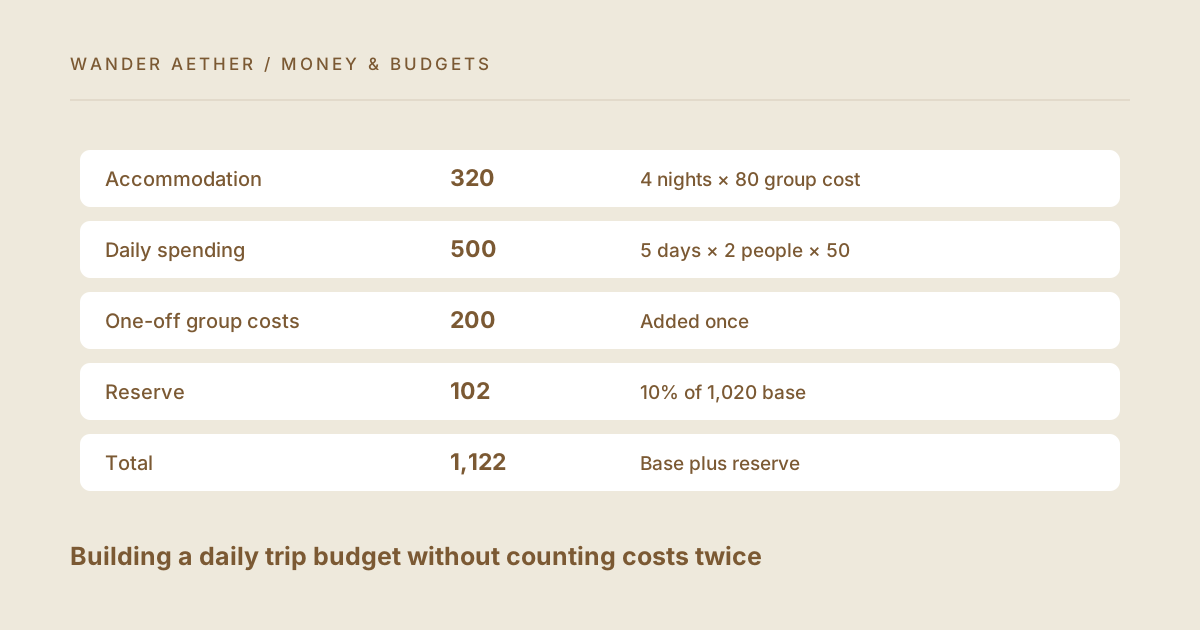
Worked example: Two travelers plan five days and four accommodation nights. Combined lodging is 80 units per night, food is 25 per person per day, local transport is 10 and activities are 15. Group one-off costs are 200. Accommodation is 320; daily spending is 5 × 2 × 50 = 500; the base is 1,020. A 10% reserve adds 102, producing a total of 1,122 and an equal planning share of 561. If the 200 already includes a sightseeing ticket, that ticket must not also be included in the daily activity average. The calculation is easy; the useful work is keeping the input categories honest.
Reference table
| Item or scenario | Value or choice | What to remember |
|---|---|---|
| Accommodation | 320 | 4 nights × 80 group cost |
| Daily spending | 500 | 5 days × 2 people × 50 |
| One-off group costs | 200 | Added once |
| Reserve | 102 | 10% of 1,020 base |
| Total | 1,122 | Base plus reserve |
Before you finish
- Use one currency for every field.
- Distinguish calendar days from actual room nights.
- Enter combined group accommodation cost per night.
- Assign every expense to exactly one frequency category.
- Describe what the buffer is intended to cover.
Your next step
Export the estimate with a short note about its prices and assumptions. When the itinerary changes, update the counts before debating whether the destination is expensive. The packing date guide and manual currency converter support this workflow by keeping dates and currency units consistent with the budget.
Continue with What a percentage currency fee does to the amount received. When your plan needs the next calculation, open Group Expense Splitter and carry over only the inputs appropriate to that tool.
A six-date stay with five paid nights
Use one unit of account for this invented two-person trip. Only the personal daily category multiplies by travelers; the room and shared transfer are already group costs. The figures illustrate frequency, not destination prices.
| Cost scope | Arithmetic | Group subtotal |
|---|---|---|
| Shared room: five nights | 80 × 5 | 400 units |
| Personal daily costs: six dates, two people | 25 × 6 × 2 | 300 units |
| One shared transfer | 60 × 1 | 60 units |
| Base, then 10% reserve | 760 + (760 × 0.10) | 836 units total; 418 each if split equally |
Make your own decision record
Currency / unit: ___
Travelers: ___
Calendar dates / usable days: ___ / ___
Paid nights: ___
Shared nightly cost × nights: ___
Personal daily cost × dates × travelers: ___
Shared one-off costs: ___
Base total: ___
Reserve percent and reason: ___
Total including reserve: ___
Costs already prepaid (avoid double counting): ___
Download example and blank worksheet (.txt)
A plain-text file you can edit or print. No account or upload is needed.