A buffer is more useful when it is linked to uncertainty than when it is chosen because a round percentage feels reassuring. It should help you see how the plan behaves when an unbooked cost changes, not conceal incomplete estimates. The trip budget tool adds the selected percentage to the whole base budget. This guide shows how to test that reserve against concrete travel scenarios without treating any percentage as universally sufficient.
Worked comparison
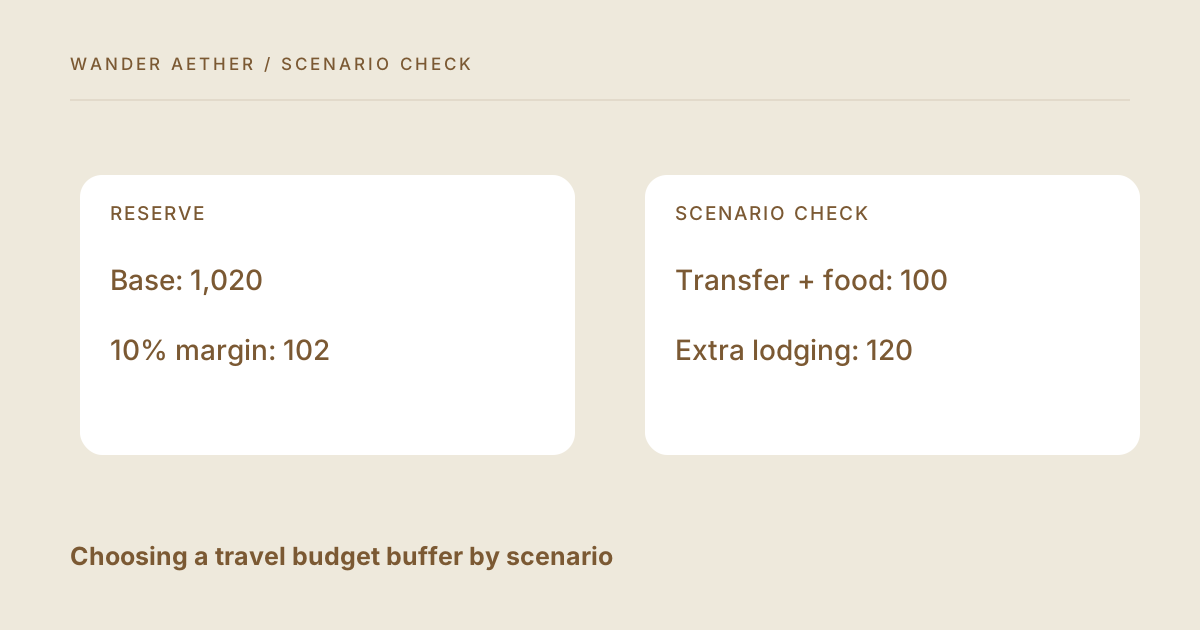
Worked example: A five-day group plan has a base estimate of 1,020 units. A 10% buffer creates a reserve of 102 and a total of 1,122. The group tests an extra 60-unit transfer plus 40 units of additional food; the combined 100-unit change fits this reserve with only 2 left. A different scenario involving an additional 120-unit lodging night does not fit by itself. Rather than declaring 10% safe, the group writes down the covered scenario and the uncovered one. They may choose a larger reserve or arrange the journey so the extra-night risk is handled another way.
Separate missing known costs from uncertain costs
A transport ticket you know you will buy belongs in the base estimate even if you have not paid for it yet. An uncertain extra transfer caused by a late arrival is a possible use for a reserve. Mixing these categories makes the reserve look larger than it really is. List known items first and obtain appropriate quotes where possible. Then identify changes that could increase spending. This sequence reveals whether the budget lacks basic information or whether it already covers the ordinary plan and needs a margin for variability.
For the next input check, use Trip Budget Planner. Its result should retain the assumptions described here.
Translate the percentage into actual money
A 10% reserve on a base of 1,000 is 100 units. On a base of 200 it is only 20. The percentage alone does not tell you what disruption can be absorbed. Read the reserve line and compare it with one plausible extra transfer, one additional meal day or another relevant expense. The comparison does not predict that the event will happen. It establishes whether the reserve matches the scenario you say it covers. If it does not, revise the plan or acknowledge the uncovered amount explicitly.
Build low, expected and higher-cost cases
Keep the ordinary plan as one case, then change specific inputs for a less expensive and a more expensive case. For example, change unbooked daily transport and activities rather than increasing every field indiscriminately. Compare the higher-cost base with the ordinary total including reserve. If the higher-cost case fits, the reserve covers that defined scenario. If not, the difference shows what would need to be cut, funded separately or booked in advance. This is more informative than trying successive percentages until the final total looks acceptable.
A related planning question is covered in What a percentage currency fee does to the amount received.
Decide how the group may use the reserve
A group can agree to keep the reserve unspent unless a specified change occurs. Without that agreement, a planning buffer may be treated as an invitation to upgrade every meal or activity. Record whether it is a shared cash pool, an individual margin or simply a number used to assess affordability. The tool does not manage funds or enforce spending decisions. It gives a total and equal planning share. Any actual payments, unequal contributions or private purchases should be tracked separately and settled under the arrangement the group agrees to.
When a larger reserve hides a weak estimate
Imagine a base plan that omits airport transfers, entry tickets and two accommodation nights. Raising the buffer from 10% to 30% might make the final number resemble a plausible total, but it does not repair the model. Those missing costs are known categories and should be added directly with their correct frequency. Only then can the reserve be evaluated against changes. This distinction is especially important when sharing a budget: another traveler may interpret the reserve as spare capacity even though it has already been consumed by omitted essentials. A transparent revision shows the new base, the new reserve and the reason each changed. The total may stay similar while the meaning becomes much stronger. Before increasing a percentage, ask which expense or scenario the extra money represents. If the answer is a booked or inevitable item, correct the input category first. If the answer is an uncertain event, test its amount against the reserve. That question keeps contingency planning from becoming a substitute for completing the cost inventory.
Reference table
| Item or scenario | Value or choice | What to remember |
|---|---|---|
| Base plan | 1,020 | Known and expected costs |
| 10% reserve | 102 | Separate planning margin |
| Extra transfer + food | 100 | Fits with 2 units left |
| Extra lodging night | 120 | Exceeds the reserve by 18 |
Before you finish
- Complete the known-cost inventory before adding a buffer.
- Read the reserve in money as well as percent.
- Test a specific higher-cost scenario.
- Document what remains outside that scenario.
- Agree how a shared reserve may be used.
Your next step
A good buffer description is a sentence you can verify: this reserve covers these specified changes at these estimated prices. That is more useful than calling a percentage safe. Save your scenario notes with the exported budget so the reserve remains understandable when someone reviews the total later.
Continue with Building a daily trip budget without counting costs twice. When your plan needs the next calculation, open Group Expense Splitter and carry over only the inputs appropriate to that tool.