An exchange rate is incomplete unless you know what one unit buys. A quote of 25 can mean twenty-five destination units for one source unit, or the reverse. The manual converter uses a single, explicit convention: one source unit equals the entered number of destination units. This guide helps you translate a quote into that convention and test the direction before using the result in a travel budget. It does not supply current rates.
Worked comparison
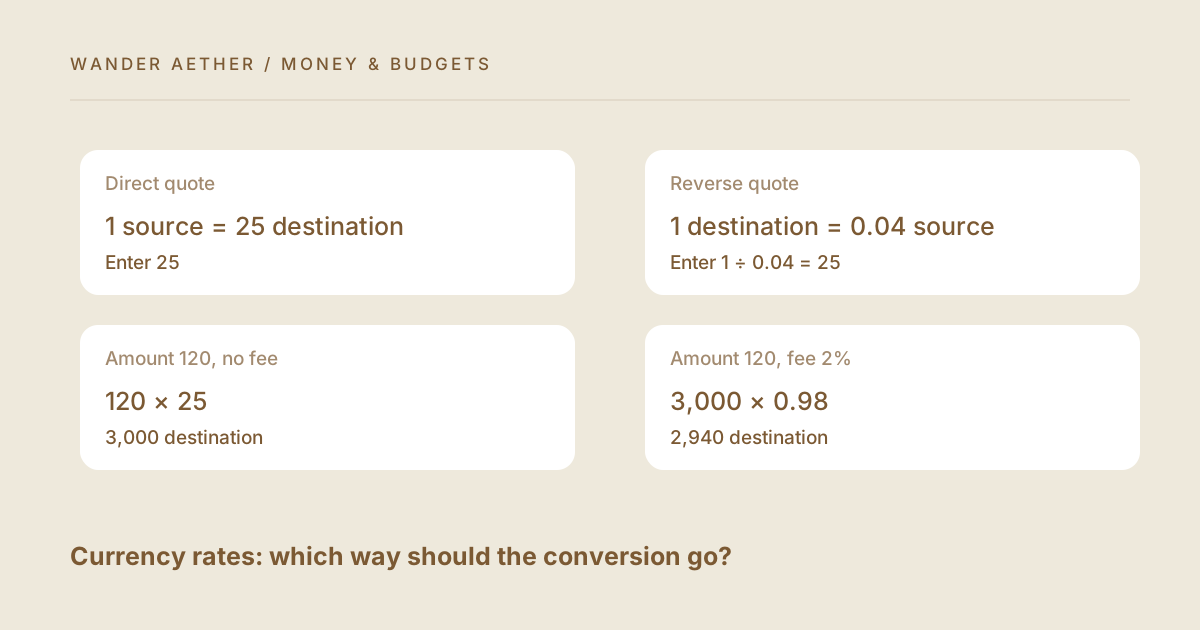
Worked example: An illustrative quote says one source unit buys 25 destination units. For a source amount of 120, enter 120 and 25. With no fee the result is 3,000 destination units. A reverse illustration says one destination unit costs 0.04 source units; divide one by 0.04 to reach the same input rate of 25. Now add a 2% fee and the output becomes 2,940 because the tool deducts 60 destination units. These numbers are deliberately hypothetical. Replacing the labels with real currencies does not turn them into a current quote or confirm that any provider will execute the transaction on these terms.
Write the unit relationship before entering numbers
Start with a sentence: one unit of the currency I am converting from equals a specified number of the currency I am converting to. Put that number in the rate field. The amount is measured in the source currency, while the output is measured in the destination currency. This simple sentence is more reliable than deciding whether to multiply or divide by intuition. Currency labels in the tool are descriptive; they do not retrieve a rate or verify the relationship. You must enter a rate from a source appropriate to your real transaction.
For the next input check, use Manual Currency Converter. Its result should retain the assumptions described here.
Invert a reverse quote carefully
If a quote says one destination unit costs 0.04 source units, the tool needs the reciprocal: one divided by 0.04, which equals 25 destination units per source unit. Preserve enough decimal places when the reciprocal is small. Rounding an extremely small rate to zero destroys the relationship and the tool rejects a zero rate. Use the original quote's precision and avoid presenting the final planning estimate as a guaranteed transaction amount. A provider may also use different buy and sell rates, so reversing the arithmetic does not necessarily reproduce the provider's reverse transaction price.
Check with a small round amount
Before converting the whole trip budget, enter a source amount of one or one hundred and read the output as a unit statement. With a rate of 25 and no fee, 100 source units should become 2,500 destination units. If the scale is wildly different from your expectation, inspect the direction and decimal position. This test catches common input mistakes without relying on a remembered market value. It verifies your interpretation of the entered quote, not whether the quote is current, fair or available to you.
A related planning question is covered in Choosing a travel budget buffer by scenario.
Keep rate uncertainty separate from spending uncertainty
A currency calculation can be arithmetically correct while the eventual trip cost differs. Rates can change, providers can apply different pricing and your destination spending can exceed the plan. Record the rate source and the time you obtained it outside the tool; it stores no automatic rate history. Use the budget reserve for a defined planning uncertainty rather than pretending the converter has priced every charge. If the actual provider quote includes an additional fixed fee, calculate that separately because this converter models only the entered percentage fee.
Why reversing a transaction is a different question
The mathematical reciprocal of a rate answers how to express the same relationship in the other direction. It does not guarantee that a provider offers that reciprocal for the reverse transaction. A provider may quote distinct buying and selling terms or apply a different charge. If you estimate converting leftover currency at the end of a trip, obtain the relevant reverse quote and write its unit relationship independently. Do not assume that money converted out and back will return to the original amount under real pricing. For an arithmetic demonstration, a no-fee rate followed by its exact reciprocal does return the same amount, subject to display rounding. That demonstration validates unit handling only. The practical workflow is to retain each transaction quote with its own source, direction and fee convention. This avoids confusing a useful mathematical identity with an available market offer. The manual tool deliberately leaves rate sourcing to you, so a label such as return exchange should be accompanied by a newly verified quote rather than the earlier outbound estimate reused without review.
Reference table
| Item or scenario | Value or choice | What to remember |
|---|---|---|
| Direct quote | 1 source = 25 destination | Enter 25 |
| Reverse quote | 1 destination = 0.04 source | Enter 1 ÷ 0.04 = 25 |
| Amount 120, no fee | 120 × 25 | 3,000 destination |
| Amount 120, fee 2% | 3,000 × 0.98 | 2,940 destination |
Before you finish
- Write out one source unit equals how many destination units.
- Check whether the provider quote is direct or reverse.
- Test a small round amount before a large conversion.
- Record where and when the manual rate was obtained.
- Calculate fixed fees separately from the percentage model.
Your next step
Use the result as a transparent arithmetic estimate. To compare providers, normalize their quotes to the same direction, amount and fee treatment before choosing a transaction. The fee guide explains how different charging conventions can produce different received amounts even when the displayed headline rate appears identical.
Continue with Splitting shared trip expenses with a cents-safe ledger. When your plan needs the next calculation, open Group Expense Splitter and carry over only the inputs appropriate to that tool.
Audit a quote by writing its units
These are invented units and rates. The model deducts a percentage from the destination gross amount. A fee charged on top, a fixed fee or a provider spread requires a different comparison.
| Step | Calculation | Meaning |
|---|---|---|
| Direct quote | 1 SRC = 1.25 DEST | Rate has units DEST per SRC. |
| Convert 100 SRC | 100 SRC × 1.25 DEST/SRC = 125 DEST | Source units cancel. |
| Deduct 2% | 125 × 0.02 = 2.50 DEST | Net received: 122.50 DEST. |
| Check inverse quote | 1 DEST = 0.8 SRC; 100 ÷ 0.8 = 125 DEST | The inverse must produce the same gross. |
Make your own decision record
Quote source and timestamp: ___
Source currency: ___
Destination currency: ___
Quote written as 1 source = ___ destination
Source amount: ___
Gross destination = source × rate: ___
Fee convention: ___
Deducted percentage / amount: ___
Net destination: ___
Other fixed fees / spread outside this model: ___
Download example and blank worksheet (.txt)
A plain-text file you can edit or print. No account or upload is needed.