Choose a Meeting Anchor When Travelers Arrive Separately
Record local dates, a specific meeting point, and a fallback so different arrivals do not depend on a vague shared clock.
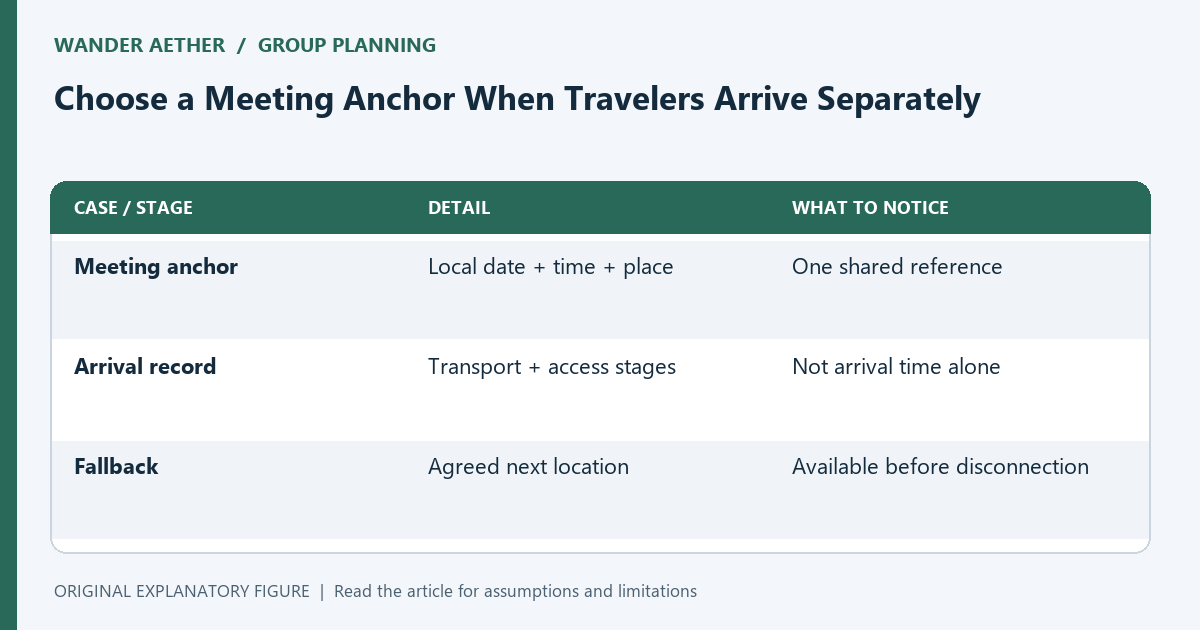
A group can agree to meet at three o’clock and still mean different dates, locations, or levels of readiness. Separate arrivals need a concrete anchor and an understandable fallback. This guide organizes that information without recommending a particular destination or transport service. Verify real schedules and location access for the actual trip.
State date, zone, and location together
Write the meeting using the destination’s local date and time plus a specific location. “Lobby, October 20, 15:00 local destination time” is more precise than “meet at three.” Include enough location detail to distinguish nearby entrances or properties.
Keep each traveler’s arrival record separate. A flight arrival is not necessarily the time that person reaches the meeting point. Immigration, baggage, transport, and other stages need their own assumptions or verified instructions.
Choose an accessible anchor
Select a place people can actually reach under their booking and access conditions. A location inside a restricted area may not work for everyone. Confirm any hours or access requirements rather than assuming a landmark is always available.
Write a simple route description or reference appropriate to the group. Avoid making the anchor depend entirely on one person’s live navigation or an unshared booking detail. Everyone should be able to identify the intended place independently.
Define the waiting rule
Agree on what happens if someone is late: how long others remain, where they go next, and how the change is communicated. This article provides the checklist; it does not establish an agreement or send messages.
A waiting rule should reflect the group’s actual circumstances. Do not invent a universal thirty-minute policy. Keep the rule explicit so a delayed arrival does not create several conflicting improvisations.
Keep a connection fallback
Record an alternative if someone cannot access the usual messaging channel. That might be a previously shared next location and time. Keep it simple and appropriate to the actual group.
Do not place sensitive personal or booking information in a publicly accessible note. Share the plan through a channel the group intends to use. A fallback needs to be available before the connection problem occurs, not designed during the interruption.
Recheck the anchor after schedule changes
If a booking changes, update the arrival stages and see whether the meeting remains realistic. Change the shared anchor deliberately rather than silently shifting one traveler’s note. Preserve the local date and zone in every version.
Use the timezone converter to compare clocks and the itinerary tool for arrival stages. The useful result is one agreed meeting record with a specific place, waiting behavior, and fallback. A time conversion alone cannot coordinate separate journeys.
| Case or stage | Detail | What to notice |
|---|---|---|
| Meeting anchor | Local date + time + place | One shared reference |
| Arrival record | Transport + access stages | Not arrival time alone |
| Fallback | Agreed next location | Available before disconnection |