Build a Transfer-Day Plan With Separate Time Reserves
Map checkout, station access, boarding, and arrival tasks so a transfer day does not accidentally become a full sightseeing day.
A transfer can occupy more of a day than the timetable suggests. The train or flight duration excludes packing, reaching the terminal, finding the right entrance, and getting to the next accommodation. This guide builds an illustrative transfer-day budget without assuming any destination’s current transport rules. Verify actual schedules and provider instructions before booking or traveling.
Name every stage
Write the day as a sequence: pack and check out, reach the departure point, complete required boarding steps, travel, reach the next accommodation, and settle in. Use your actual booking for the provider-specific stages. A departure time is a constraint, not the start of all preparation.
Mark which stages you can estimate and which need verification. An unknown station entrance or baggage process deserves a question in the plan. Do not turn an unknown duration into zero merely because the timetable omits it.
Keep reserves separate from scheduled time
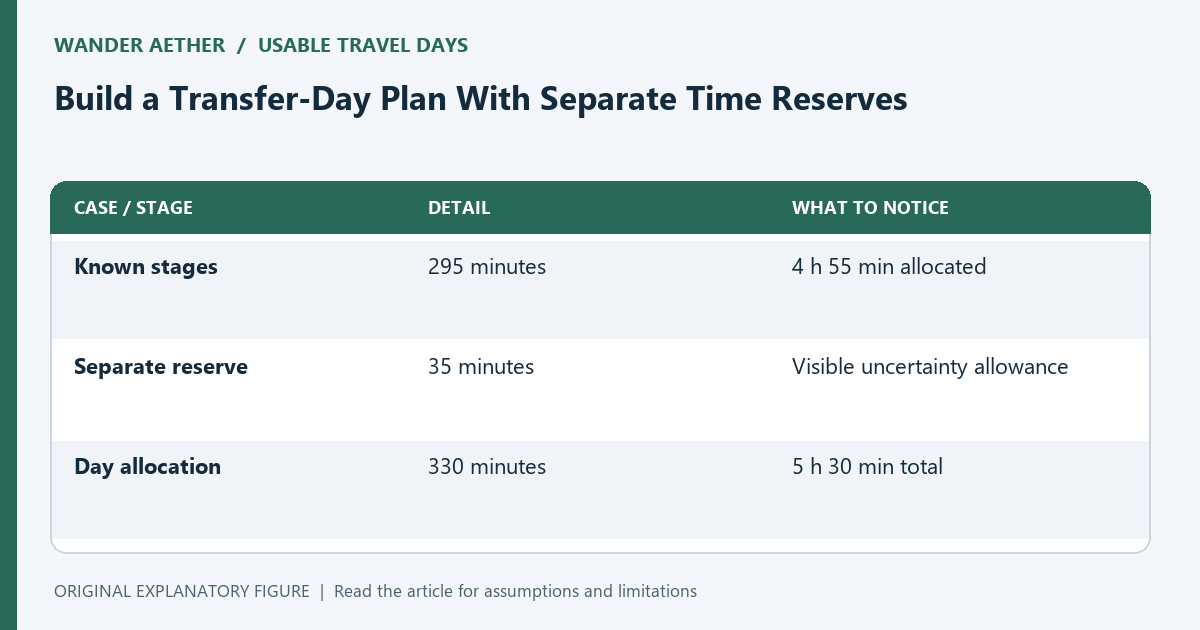
In an invented example, preparation takes 45 minutes, access 40, a boarding allowance 30, travel 120, and arrival tasks 60. The total is 295 minutes, or 4 hours 55 minutes. An additional 35-minute reserve brings the planning allocation to 330 minutes.
These are example assumptions, not recommended airport or train arrival times. The reserve is visible so you can change it independently. If you mix it into every stage, you may double-count caution or lose track of which uncertainty you are addressing.
Work backward from fixed commitments
If the departure is fixed, calculate the latest planned start by subtracting preparation and access stages from the required arrival point. Use provider guidance for when you need to be present. Keep the clock’s local time zone and date explicit.
Then inspect the previous evening: packing or transport verification may fit better there. Moving a task is useful only if you have an actual place for it. Do not erase it from the day budget while quietly assuming it happens for free.
Choose a small optional activity
After allocating the transfer, meals, and settling in, see what usable time remains. Pick an activity near the arrival area with a clear stop time and an easy exit. Avoid treating the remainder as a normal full sightseeing day.
List an optional activity as optional. If the transfer runs late, you can drop it without damaging the core plan. Check any opening hours or reservations separately when you select a real venue; this generic calculation cannot verify them.
Review the day as a sequence
Use the itinerary tool to inspect the time budget and the timezone tool when the clocks differ. Keep one written plan with local dates, fixed commitments, stage estimates, and reserve. That is easier to use under pressure than scattered notes.
After the trip, compare one or two estimated stages with what happened. Update your future assumptions without claiming the same duration applies everywhere. The useful lesson is which stage you omitted or underestimated, not a universal transfer-time rule.
| Case or stage | Detail | What to notice |
|---|---|---|
| Known stages | 295 minutes | 4 h 55 min allocated |
| Separate reserve | 35 minutes | Visible uncertainty allowance |
| Day allocation | 330 minutes | 5 h 30 min total |