Settle Shared Trip Costs When People Join on Different Days
Separate whole-group expenses from night-based and individual costs with a transparent worked example.
An equal split is simple until one traveler arrives late or leaves early. A fair-looking total can hide different assumptions about who benefited from each cost. This guide uses invented amounts to show a transparent method. It is an organizational example, not legal or financial advice, and the group should agree on the allocation before the expense is incurred.
Classify costs before calculating balances
Separate costs by allocation rule: everyone participating in an activity, person-nights for an agreed lodging split, and individual items. An expense label alone is insufficient. A taxi might be shared by everyone or by two people only.
Write the participant list beside each expense. If the group agrees to subsidize a late arrival or reserve an unused bed, record that explicit agreement. Do not let the spreadsheet make a social decision by silently including or excluding someone.
Use person-nights only when agreed
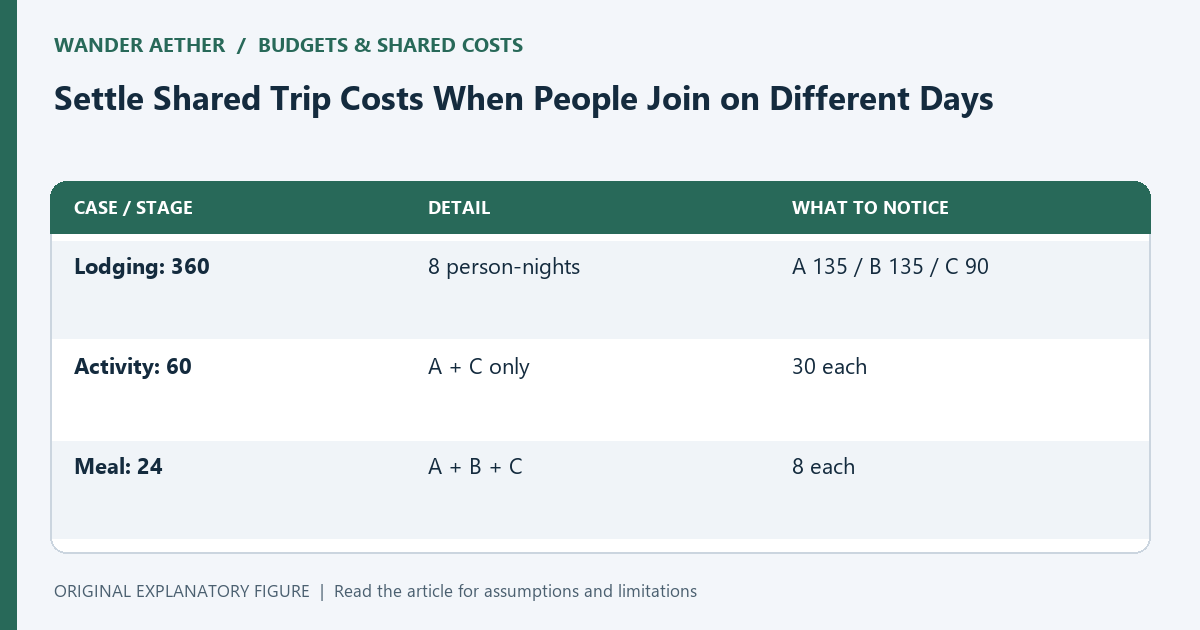
In an invented lodging example, a shared stay costs 360 units. A stays three nights, B three, and C two. There are eight person-nights, so an agreed person-night allocation is 45 units each: A owes 135, B 135, and C 90.
This rule is not inherently correct for every booking. A fixed room price, separate bedrooms, or a cancellation commitment can support a different agreement. The point is to state the rule clearly and show the arithmetic that follows from it.
Keep activity costs on their own participant list
Suppose A and C share an activity costing 60 units while B does not attend. Split that cost 30 each between A and C. Do not spread it across the lodging person-night denominator, because it belongs to a different participation group.
Add a 24-unit meal shared by all three, giving 8 each if that is the agreed rule. The resulting shares are A 173, B 143, and C 128. They add to the 444-unit expense total, which is a useful arithmetic check.
Separate shares from who paid
An allocated share describes responsibility for cost. A payment record describes who advanced the money. If A paid all 444 units, B owes A 143 and C owes A 128 in this simplified single-currency example.
If several people paid, sum each person’s payments and subtract their allocated share to get a net balance. Keep receipts and any conversion convention together. Do not merge currencies without an agreed conversion method and date; this example deliberately uses one unit throughout.
Review the ledger before settling
Show the group the expense, participant rule, payer, and calculated shares. Resolve disputed participation or rounding before reducing the ledger to transfers. Keep rounding adjustments visible so all balances still sum to zero.
Use the expense splitter for a compatible shared-cost calculation and retain a separate note for rules the tool does not model. A final payment should be explainable from the ledger. The useful outcome is agreement on the assumptions as well as a matching total.
| Case or stage | Detail | What to notice |
|---|---|---|
| Lodging: 360 | 8 person-nights | A 135 / B 135 / C 90 |
| Activity: 60 | A + C only | 30 each |
| Meal: 24 | A + B + C | 8 each |