Packing cubes can make a bag easier to use, but they do not make clothing weigh less. Compression may change volume while the organizer itself adds mass. This distinction matters when the constraint is weight rather than space. The baggage calculator can include cubes, pouches and compression bags as ordinary item rows. This guide helps you evaluate their practical value and keep the inventory honest without making a universal recommendation for or against organizers.
Worked comparison
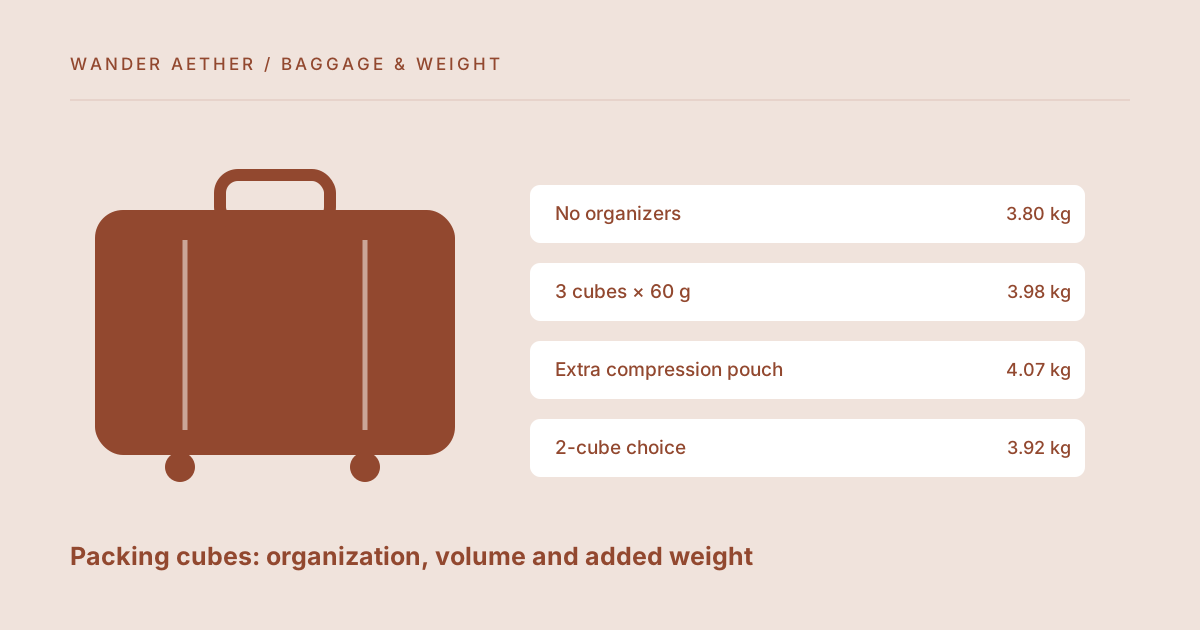
Worked example: A traveler has 3.8 kg of bag and contents before organizers. Three empty cubes at 60 g each add 180 g, bringing the estimate to 3.98 kg. A compression pouch makes the clothing section smaller but adds another 90 g, so the weight becomes 4.07 kg. He decides two cubes are enough because one holds the rotation and the other separates clean spares. The two-cube version is 3.92 kg and easier to search than the original. That is a useful, measurable compromise. It reduces organizational friction without pretending that compressed clothes have lost mass.
Separate the constraints you are trying to solve
If the bag is difficult to search, organization may be the main problem. If it cannot close comfortably, volume may be the problem. If it exceeds a weight allowance, compression alone will not solve that weight issue. Identify the constraint before buying or adding an organizer. A compressed bag can be heavier than expected because it allows more contents to fit. The tool's weight result should therefore include all actual items after organizing, not a smaller imaginary wardrobe inferred from the compact appearance of the bag.
For the next input check, use Baggage Weight Estimator. Its result should retain the assumptions described here.
Measure empty organizers as equipment
Weigh each cube or pouch empty and enter it as a row. Include any outer compression case and accessories that remain in the bag. If you instead weigh a fully packed cube as one row, do not also list its contents separately. Choose either a container-plus-contents breakdown or a measured packed-unit approach and keep the scope consistent. The breakdown is better for comparing individual garment removals; the packed-unit approach may be faster for a stable kit. Both can work if you avoid counting the same mass twice.
Organize around use rather than appearance
A cube for daily clothing, a pouch for arrival essentials and a separate laundry bag can reduce repeated unpacking. Dividing items into too many small containers may make access slower and add unnecessary weight. Consider when you need each group and whether it stays together throughout the trip. A perfectly color-coordinated arrangement has little value if the first required charger is buried under every clothing cube. The packing checklist can help identify those first-use groups before you decide which organizers earn their place.
A related planning question is covered in Checking a carry-on limit: weight is only one requirement.
Compare the organized and unorganized versions
Weigh the same contents with and without the proposed organizers. Test how quickly you can access an arrival item and how easily the bag closes. The added grams may be worthwhile if they materially improve use; a small gain in appearance alone may not matter to you. Keep some flexible room rather than compressing to the point where each opening requires a complete repack. Any claims about airline fit still require checking the packed dimensions and ticket conditions. Organization is a usability choice, not a certification mechanism.
One packed-unit method for a stable kit
For a familiar travel kit, you might weigh a packed cube as a unit and enter Daily clothing cube, 1250, 1. That is acceptable if the 1,250 g includes the cube and everything inside it, and none of those contents appears elsewhere in the inventory. Mark the row as a packed unit in your private notes. If you later remove a top, reweigh the unit or switch to a detailed container-plus-contents breakdown. Do not subtract an estimated garment weight and then forget that the measurement no longer describes the original packed cube. This method is convenient for stable kits such as a small charging pouch, but it reduces visibility into individual contributors. Choose the level of detail according to the decision you need to make. When comparing organizers, the detailed method is clearer because it separates the organizer's added mass. When checking a routine finished kit, a verified packed-unit measurement can be faster and less error-prone than repeatedly entering every small accessory.
Reference table
| Item or scenario | Value or choice | What to remember |
|---|---|---|
| No organizers | 3.80 kg | Baseline contents unchanged |
| 3 cubes × 60 g | 3.98 kg | Adds 180 g |
| Extra compression pouch | 4.07 kg | Smaller volume, higher mass |
| 2-cube choice | 3.92 kg | Organization with less added equipment |
Before you finish
- Identify whether the problem is access, volume or weight.
- Weigh containers and include them in the inventory.
- Avoid listing a packed cube and its contents twice.
- Group items by when they are needed.
- Compare practical access as well as the final total.
Your next step
The best organizer is one that solves a problem in your own bag at an acceptable cost in space and weight. Record its measured mass for future inventories. If the bag is still too heavy, review item quantities and heavy contributors rather than expecting another compression method to change the arithmetic.
Continue with Finding the items that drive packing weight. When your plan needs the next calculation, open Clothing Rotation Calculator and carry over only the inputs appropriate to that tool.