Leave a Measured Baggage Reserve for Items Bought on the Trip
Compare departure weight, verified allowance, and return-item estimates without assuming the outbound bag represents the return trip.
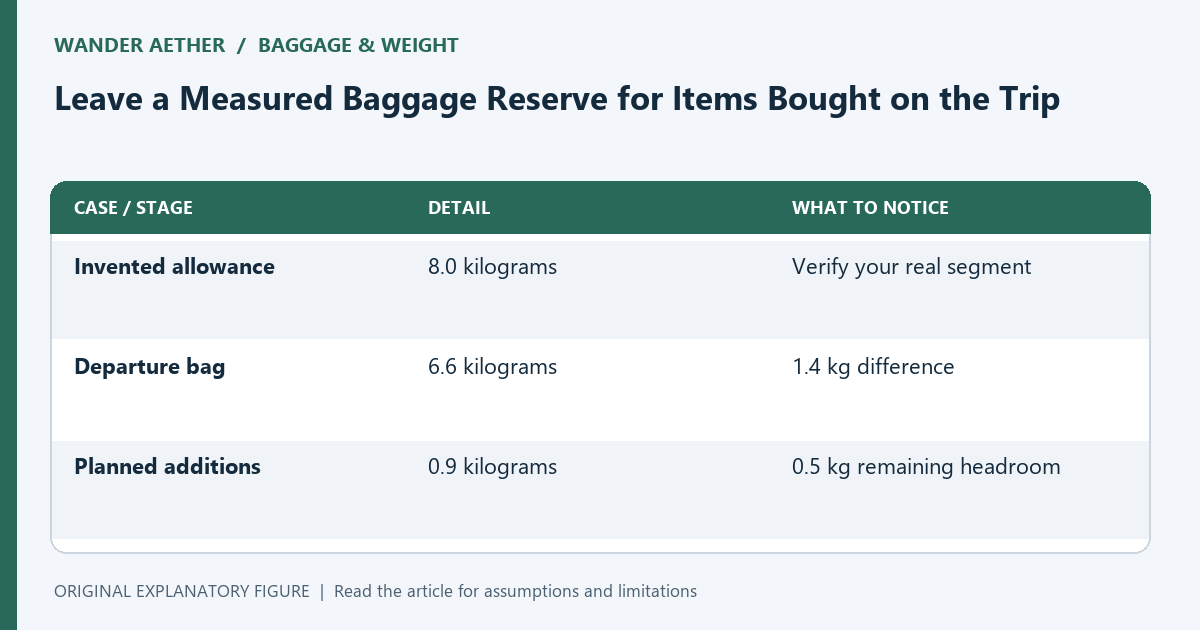
A bag that fits your outbound plan can exceed the same limit on the way home after you add purchases or wet clothing. A return reserve makes that possibility visible before departure. This guide uses invented weights and requires you to verify the actual allowance for each transport segment. It is not a statement of any airline’s current baggage policy.
Verify each relevant allowance
Record the provider, segment, bag type, and applicable size or weight condition. The return trip may use a different provider or fare. Do not assume a rule copied from an old trip still applies.
Keep the current official source with your note. If the allowance is unknown, mark it as unresolved rather than assigning a convenient value. A calculator can total your inventory but cannot confirm the policy attached to your booking.
Measure the departure inventory
Weigh the empty bag and the items you intend to carry. Include small accessories and packaging that will remain in the bag. A list of quantities is not a weight inventory until its values are measured or clearly estimated.
Use one unit consistently. If some rows use grams and the bag value uses kilograms, follow the tool’s field labels and conversion. Avoid mixing a worn-item assumption with a packed-item total without recording the difference.
Create an explicit return reserve
For an invented allowance of 8 kilograms and a departure bag of 6.6 kilograms, the difference is 1.4 kilograms. Reserving 0.9 kilograms for planned purchases leaves 0.5 kilograms of additional headroom.
These values are example arithmetic, not a suggested allowance or a safety margin that works everywhere. Packaging, moisture, and scales can affect the final weight. Keep the reserve and headroom visible as separate planning quantities.
Review space as well as weight
A lightweight purchase can be bulky or fragile. Check whether it fits the bag dimensions and whether its protection adds weight. A numerical reserve does not solve every packing constraint.
Before buying an actual item, inspect its final packaged form and any relevant transport rules. This workflow does not determine whether a particular item is permitted. Verify restrictions through the appropriate official provider information.
Reweigh the final return bag
Use the completed return inventory rather than subtracting an approximate purchase total from memory. If it exceeds a verified condition, review the available options through the provider’s current rules before traveling.
Use the baggage-weight tool for the inventory and the carry-on-limit guide for the verification process. The useful plan shows departure weight, return additions, and remaining headroom. It does not claim that a single outbound weigh-in guarantees the bag will meet every later condition.
| Case or stage | Detail | What to notice |
|---|---|---|
| Invented allowance | 8.0 kilograms | Verify your real segment |
| Departure bag | 6.6 kilograms | 1.4 kg difference |
| Planned additions | 0.9 kilograms | 0.5 kg remaining headroom |