Keep Currency Conversion Rounding Separate From Expense Shares
Use invented rates to inspect line-by-line versus total conversion and preserve a visible rounding adjustment.
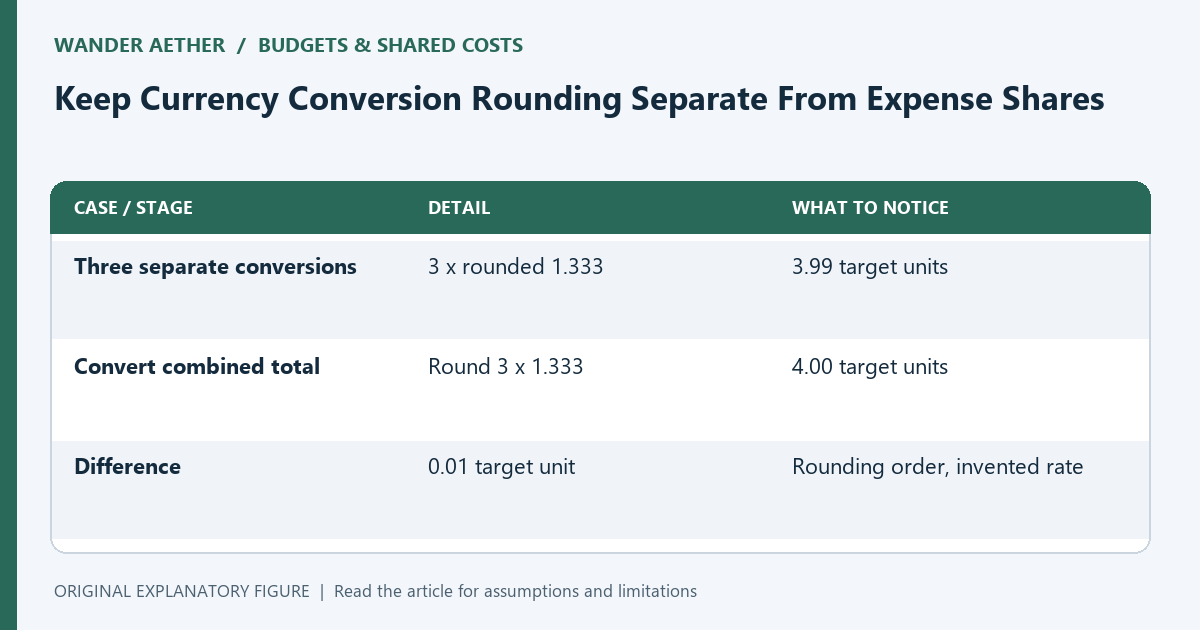
Converting each receipt and then splitting can produce a slightly different total from converting the combined amount. Rounding and the chosen rate convention explain some differences. This guide is an illustrative ledger exercise, not financial advice or a live exchange-rate quote. Agree on the group’s conversion convention before settling actual expenses.
State the rate direction
Write the rate as one unit of source currency equals a stated number of target units. Use names or labels for both currencies. A bare rate such as 1.25 is incomplete because multiplying in the wrong direction changes the result.
Use the actual rate source and convention agreed by the group for real expenses. This site’s converter accepts a manual rate and does not provide a live feed. A number entered in the form is an assumption, not a verified current quote.
Use a small rounding fixture
Imagine three receipts of 1.00 source unit each and an invented rate of 1.333 target units per source unit. Rounding each converted receipt to two decimals gives 1.33, for a total of 3.99.
Converting the source total of 3.00 first gives 3.999, which rounds to 4.00. The 0.01 difference comes from rounding order. The fixture is intentionally simple so the cause can be inspected without market movements or fees.
Choose a convention deliberately
Decide whether the ledger records rounded converted receipt amounts or maintains higher precision until a later total. Keep that decision with the rate. Different workflows can be reasonable, but mixing them creates unexplained balances.
The appropriate display precision depends on the currency and payment context. The two-decimal example is not a rule for every currency. Confirm actual settlement requirements rather than assuming all currencies use the same smallest unit.
Separate allocation from conversion
First identify each expense’s participants and agreed share rule. Then apply the documented conversion and rounding process. If a final split leaves a small remainder, record who receives the adjustment or how it is handled.
Do not hide a rounding remainder by silently changing a receipt. The shares should sum to the ledger total under the chosen convention. Keep fees separate when they apply so a fee is not mistaken for a rounding difference.
Review the ledger before payment
Show source amounts, rate direction, conversion convention, shares, and adjustment. Resolve disagreement about the rate or participants before simplifying the ledger into transfers. Preserve receipts and the agreed record.
Use the manual currency converter for arithmetic and the expense splitter for compatible single-currency shares. Neither chooses a fair convention automatically. The useful outcome is a reproducible ledger whose small differences are explained, rather than a falsely exact number detached from its assumptions.
| Case or stage | Detail | What to notice |
|---|---|---|
| Three separate conversions | 3 x rounded 1.333 | 3.99 target units |
| Convert combined total | Round 3 x 1.333 | 4.00 target units |
| Difference | 0.01 target unit | Rounding order, invented rate |