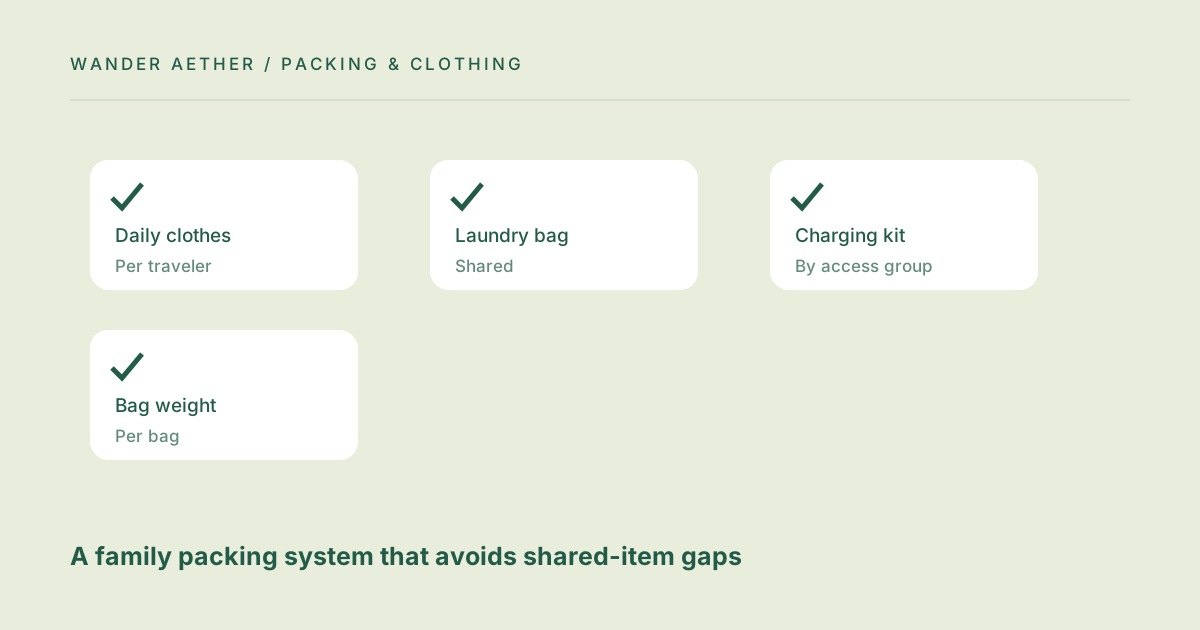
Family packing fails as often through unclear responsibility as through an incomplete list. Everyone may assume someone else packed the charger, while three people bring the same organizer. The packing builder provides combined quantities for up to twelve travelers, but it cannot know ages, individual sizes or personal needs. Use the output as an inventory framework, then assign each shared item and review each person's own kit before departure.
Before you finish
- Assign one responsible owner to every shared line.
- Replace uniform quantities where individual needs differ.
- Avoid recording sensitive document data in the checklist.
- Check shared items physically before closing bags.
- Weigh each bag against the rules applicable to it.
Build one household inventory, then divide ownership
Begin with the total traveler count and generate the list for the trip conditions. Mark which lines are personal and which can genuinely be shared. Give each shared line one owner who is responsible for packing it and checking that it is accessible. Other people can help, but responsibility should remain clear. This is particularly useful when bags are packed in separate rooms or at different times. A message that someone plans to pack an item is not the same as a final check that the item has reached the correct bag.
Do not treat every traveler as an identical adult
The generated clothing quantities use the same rotation logic for each traveler. Individual travelers may need more changes, different footwear, different toiletries or items absent from the general list. Replace group totals with per-person sublists where those differences matter. Names or initials in a private downloaded checklist are often enough; there is no need to enter sensitive personal details into the tool. The list is processed locally and is not saved automatically, but a downloaded family file still deserves sensible handling on a shared computer.
For the next input check, use Packing List Builder. Its result should retain the assumptions described here.
Use a final physical handoff
Before closing bags, have the item owner point to each shared item in its packed location. Review quantities for each person without emptying every bag: packing cubes or labelled pouches can make this easier. Then weigh bags individually; an acceptable group weight total can conceal one overweight bag. Avoid assuming an airline will pool allowances across travelers, because that depends on the booking and rules. After the trip, record which shared items were inconvenient to share. That feedback improves the ownership plan more effectively than adding duplicates to everything.
A related planning question is covered in A seven-day packing list with one laundry stop.
If the family separates for a day
A shared plan should survive an ordinary split in the itinerary. Imagine two travelers taking a day trip while the others stay near the accommodation. Review chargers, water containers, document access and any other items previously treated as one shared unit. Decide which subgroup needs which item and whether there is an agreed handoff before departure. If both groups need the same item simultaneously, duplication may be justified despite the extra weight. Update ownership and bag location, not just quantity. When the subgroups reunite, confirm that borrowed shared items return to their expected place before the next transfer. This is a simple operational check that prevents an item from being left in a daypack packed away in another room. The original group inventory still helps prevent accidental duplication, but it must reflect how the family actually moves. A list optimized only for everyone staying together may be smaller on paper and less useful in practice. Add a short split-day note to the downloaded checklist when the itinerary calls for one.
Worked example
Worked example: Four travelers take a six-day trip with laundry every three days. The builder suggests sixteen tops, underwear and sock sets in total: four per person, including one spare. The household replaces this group line with four named sublists so sizes and individual changes are checked separately. Two adults each take responsibility for a charging kit used in their respective rooms. One person packs the shared laundry bag, another carries the document folder. Each traveler still has their own personal essentials. The group weighs the bags separately and moves a shared organizer from the heaviest bag to the lightest only after confirming everyone can still access it when needed.
Reference table
| Item or scenario | Value or choice | What to remember |
|---|---|---|
| Daily clothes | Per traveler | Use named sublists for different requirements |
| Laundry bag | Shared | One owner and one known location |
| Charging kit | By access group | Consider separate rooms and simultaneous use |
| Bag weight | Per bag | Do not assume allowances can be pooled |
Your next step
The final family checklist should answer two questions for every important item: who checked it, and where is it? A single combined list is useful for planning, but ownership and access make it usable on travel day. Keep the downloaded list available to the people packing rather than depending on one open browser tab.
Continue with Packing a weekend into one carry-on. When your plan needs the next calculation, open Baggage Weight Estimator and carry over only the inputs appropriate to that tool.