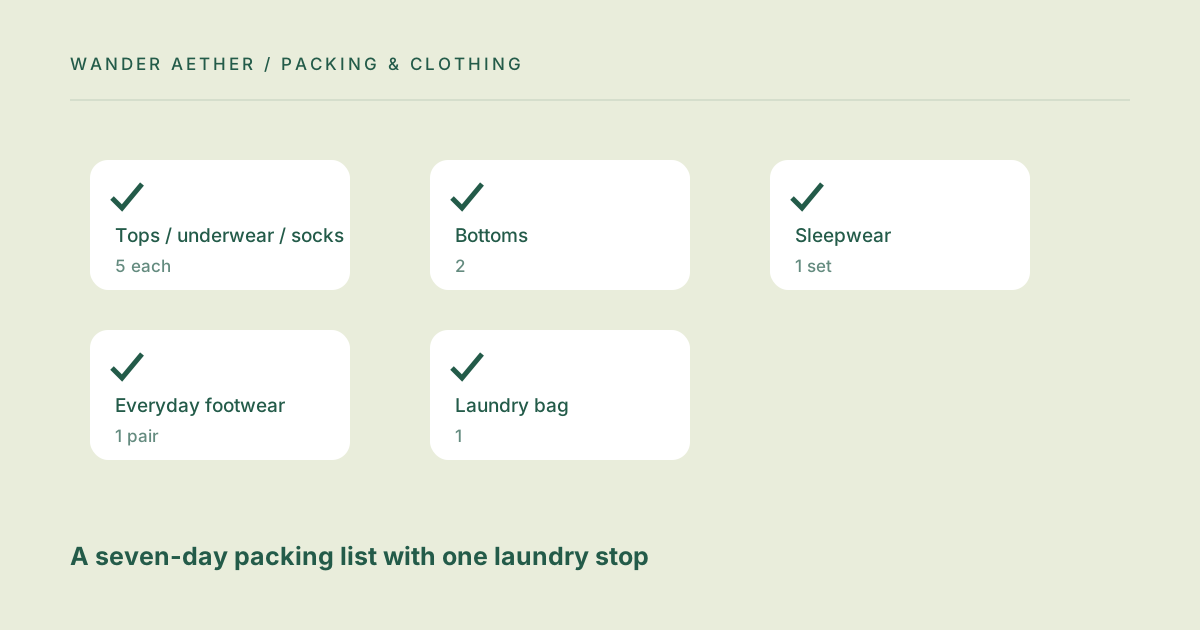
A week away does not automatically require seven of every garment. The deciding question is whether you can reliably wash and dry clothes during the trip. A four-day rotation can cover seven days when the first wash is finished before the next clean outfit is needed. This guide builds a list for one adult, mild weather, ordinary city walking and a confirmed laundry opportunity. Change those assumptions before borrowing the counts for your own journey.
Before you finish
- Confirm opening hours and drying arrangements for the wash.
- Count the departure outfit in the clothing totals.
- Assign shared items to a named traveler.
- Add activity-specific clothing only for booked or likely activities.
- Weigh the bag after chargers and toiletries are packed.
Start with the calendar, not the suitcase
Write down departure day, return day and the first realistic laundry evening. Count clothing worn while traveling as part of the rotation. If you arrive late on day four and the laundry closes early, that is not a usable wash day. Move the laundry interval to five days or bring another clean set. A calendar with one dependable wash is more useful than a promise to wash whenever you happen to find a machine. Drying time belongs in the schedule too: a washed shirt that is still damp in the morning cannot solve a clean-clothes shortage.
Choose a small, compatible clothing rotation
Use five tops, five underwear items and five pairs of socks as a starting example: four days before laundry plus one spare. Two bottoms can cover that rotation if your activities and comfort allow repeated wear. Add sleepwear, an everyday shoe pair and a light layer. These are planning assumptions, not hygiene rules. Hot weather, active days or personal preferences may require more frequent changes. Select colors and shapes that work together so each top has more than one usable pairing. Do not add an entire second wardrobe just because one evening is slightly dressier.
For the next input check, use Packing List Builder. Its result should retain the assumptions described here.
Pack by the first use of each item
Put arrival essentials where they can be reached without opening every cube. The clothing rotation can sit deeper inside the main bag. Keep a clean spare set available for delays or spills rather than burying it under everything else. As you place each item, mark the checklist and check its quantity against what is actually in the bag. A checklist is a record of completion, not proof that an item was packed just because it was suggested. Finish by weighing the fully packed bag, including the bag itself and any items added at the door.
A related planning question is covered in Packing a weekend into one carry-on.
When the laundry appointment moves
Suppose the Thursday wash moves to Friday because your accommodation changes. A four-day cycle is no longer the right input if you need clean clothes through Friday morning. Recalculate with five days between laundry and compare the quantities. The change adds one to each daily clothing category but may not add a bottom under the reuse convention. This is why an update should follow the actual formula rather than adding an entire outfit indiscriminately. Check whether the revised clothing still fits and whether you need another laundry supply. If Friday drying is uncertain, use a longer interval or no laundry instead of recording the best possible outcome as the plan. The spare remains a spare only while the ordinary rotation is covered. If you routinely plan to wear it before the wash, it has become part of the base cycle and the buffer has disappeared. A simple calendar note identifying the last clean morning before laundry is enough to make this boundary visible to anyone reviewing the list.
Worked example
Worked example: Maya travels Monday through Sunday and has a washer available Thursday afternoon. In the builder she selects seven days, mild weather, city travel, one traveler and laundry every four days. The list suggests five tops, underwear and sock sets, two bottoms and one spare within the rotation. She wears one top and one bottom in transit, so those pieces are not added a second time. On Thursday she washes the used clothes and keeps the fifth set clean. If the laundry plan disappears, she recalculates with no laundry and gets eight daily sets including the spare. The resulting difference is a clear decision: confirm the wash or accept more volume.
Reference table
| Item or scenario | Value or choice | What to remember |
|---|---|---|
| Tops / underwear / socks | 5 each | Four-day cycle + one spare |
| Bottoms | 2 | Assumes comfortable repeat wear |
| Sleepwear | 1 set | Separate from daily rotation |
| Everyday footwear | 1 pair | Includes the pair worn in transit |
| Laundry bag | 1 | Shared if traveling together |
Your next step
Keep the plan reversible. Save the checklist as text, then add any personal essentials the general list cannot know about. The useful result is a rotation you understand, not a long inventory you follow without checking. Use the clothing calculator to explore a different wash interval before you remove a spare set.
Continue with How to calculate a travel laundry rotation. When your plan needs the next calculation, open Baggage Weight Estimator and carry over only the inputs appropriate to that tool.
Seven-day kit: test the laundry assumption
Illustrative case: one traveler, seven wear days, laundry every three days and one spare set. A laundry interval is useful only if clean, dry clothes are available before the next rotation begins.
| Decision | Calculation or observation | Action |
|---|---|---|
| Reliable laundry | min(7, 3 + 1) = 4 sets | Start with four tops, underwear and sock sets. |
| Laundry slips to day five | min(7, 5 + 1) = 6 sets | Recalculate to six sets or confirm a reliable wash. |
| No laundry | min(7, 7 + 1) = 7 sets | Cover seven wear days under this tool convention. |
| Worn on departure | One of the total sets | If one is worn, three of the four sets go in the bag. |
Make your own decision record
Wear days: ___
Travelers: ___
Reliable clean-and-dry interval: ___
Spare sets: ___
Sets per person = min(days, interval + spare): ___
Worn sets: ___
Packed sets = total minus worn: ___
Wash location / drying time confirmed: ___
Personal changes to the default list: ___
Download example and blank worksheet (.txt)
A plain-text file you can edit or print. No account or upload is needed.