Count Hotel Nights Separately From Usable Trip Days
Distinguish date difference, nights, inclusive calendar dates, and partial arrival or departure days.
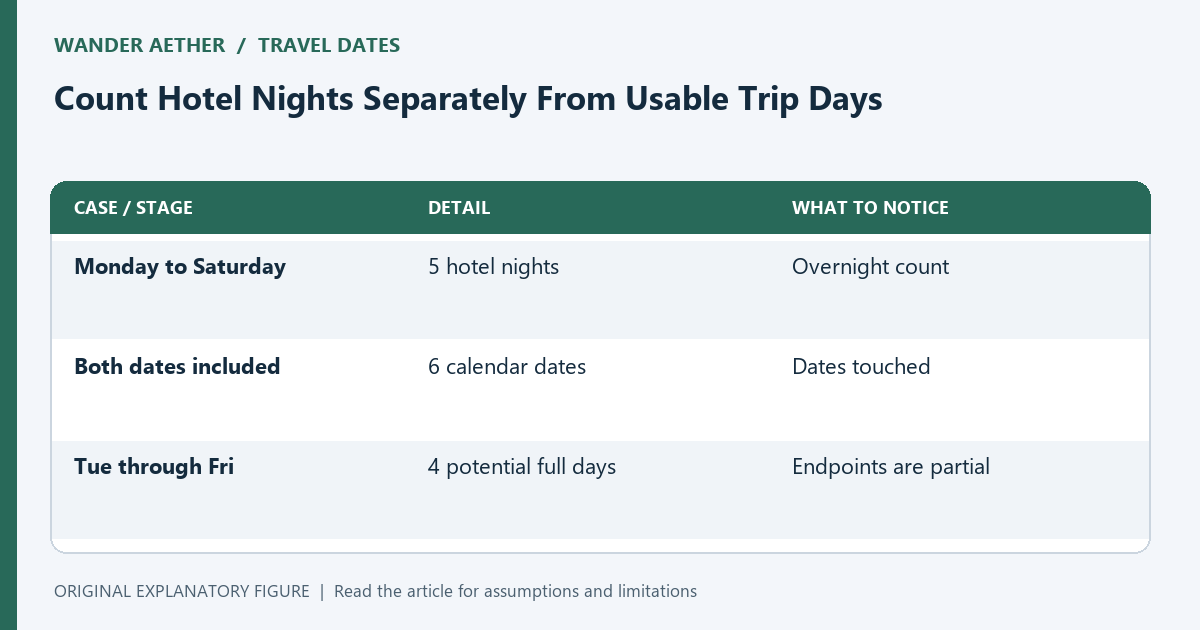
A five-night reservation can touch six calendar dates and still leave fewer than five full days for activities. Those counts answer different questions. This guide follows an invented Monday-to-Saturday stay and shows how to label the numbers so a packing plan, budget, and itinerary do not accidentally use the same count for different purposes.
Write the arrival and departure dates
Suppose check-in is Monday and check-out is Saturday. In the ordinary overnight sequence, the stay includes Monday, Tuesday, Wednesday, Thursday, and Friday nights: five nights. It touches six calendar dates when both endpoints are included.
Keep hotel nights separate from a date-difference tool’s output. A tool may calculate elapsed days or count endpoints differently. Read its labels and verify with a small example you can list by hand before using it for a more complicated trip.
Mark partial days explicitly
If arrival reaches the hotel at 18:00 and departure preparation begins at 09:00, neither endpoint is a full sightseeing day. Tuesday through Friday provide four potential full days in this example. Monday evening and Saturday morning are separate partial windows.
Those clock assumptions are illustrative. Your actual travel, luggage access, check-in conditions, and transport connections determine what is usable. Avoid multiplying a full-day activity plan by six simply because the itinerary touches six dates.
Match each planning category to its denominator
Accommodation uses nights. Some meals use specific calendar occasions. Activities use usable windows. Clothing can depend on wear occasions and laundry access rather than either nights or full days alone.
For the sample stay, you might budget five dinners if one is planned on each evening from Monday to Friday. That does not imply five lunches or five full tours. Write the actual occasions for categories where a blanket per-day multiplier would overcount or undercount.
Keep local dates on overnight transfers
A transfer crossing midnight or a time zone can change the destination calendar date. Record departure and arrival with local dates and zones from the actual booking. Do not infer the arrival date from a duration alone.
Use the timezone converter when comparing clocks, then return to the destination’s local date for the overnight plan. A flight night and a hotel night are not automatically interchangeable, especially when accommodation begins before or after the transfer.
Reconcile the itinerary before booking extras
Create a short summary: five hotel nights, six touched dates, four potential full activity days, and two partial windows. Check it against every reservation and transfer. Mark assumptions that need provider confirmation.
Use the date counter to verify the interval and the itinerary tool for the usable windows. For real activities, confirm current hours and reservation conditions separately. Clear labels protect the plan from a common counting error without pretending that every calendar day offers the same time.
| Case or stage | Detail | What to notice |
|---|---|---|
| Monday to Saturday | 5 hotel nights | Overnight count |
| Both dates included | 6 calendar dates | Dates touched |
| Tue through Fri | 4 potential full days | Endpoints are partial |